
Focus On Perfection
Chess Photography – The Art of Capturing a War in Silence 4 Sections162 Lessons5 Quizzes10 Weeks
LESSON 2.5 • 6. Kit number 3 – The professional photojournalist at an international competition
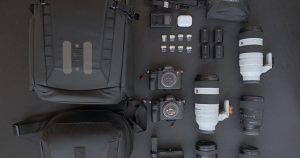
Now we’re entering a situation where we can’t really afford surprises anymore.
Let’s say you represent a sports publication and you have to photograph an international final.
The editorial team needs images for the website, social media and an editorial piece.
The organizer gives you limited access.
You have to shoot quickly, discreetly and deliver the photos by a set deadline.
This is where I’d start seriously thinking about a two-camera setup.
Why two cameras?
The first reason is flexibility.
You can have a standard zoom on one camera and a telephoto lens on the other.
You no longer change lenses when you go from a wide shot to a portrait.
The second reason is safety.
If the main camera breaks down, you have a backup.
But be careful: two cameras don’t necessarily mean two cameras hanging off you in the playing area.
If access is tight, one can stay in the media area or in a secure location.
Indicative professional setup
| Gear | Use |
|---|---|
| Camera A | Reportage and wide shots |
| 24–70 mm f/2.8 | Atmosphere, players, context |
| Camera B | Portraits and action from a distance |
| 70–200 mm f/2.8 | Expressions, hands, reactions |
| 85 mm f/1.8, optional | Portraits in low light |
| Spare batteries | Continuity and safety |
| Fast, redundant cards | Protecting the images |
| Laptop and card reader | Selection and editing |
| External SSD | Extra copy |
| Discreet bag | Transport and organization |
The first camera – The full story
On camera A I’d mount a 24–70 mm f/2.8.
I’d use this setup for the atmosphere of the hall, both opponents, the playing table and editorial shots with context.
For example:
1/250 s • f/4 • Auto ISO • AF-C or AF-S, depending on the subject
The second camera – The moments that make the difference
On camera B I’d mount a 70–200 mm f/2.8.
I’d look for the glances, hands, expressions and reactions that I can’t photograph tightly enough with the standard lens.
Starting point:
1/400 s • f/2.8 • Auto ISO • AF-C
If the photo involves a fast move, I might use a faster shutter speed.
But not automatically.
What is essential with two cameras?
Setting them up before the competition.
Both must have the correct time, cards, batteries and tested shutter modes.
If each camera has a completely different white balance, editing and making the series consistent become more complicated.
And if one is silent while the other fires a noisy mechanical shutter, you have a serious problem.
A professional kit isn’t just bigger. It also has to be better organized.