
Chess Photography – The Art of Capturing a War in Silence 4 Sections162 Lessons5 Quizzes10 Weeks
Curriculum
- 4 Sections
- 162 Lessons
- 10 Weeks
- MODULE 1 – INTRODUCTION TO CHESS PHOTOGRAPHY52 ItemsIn chess we don’t have spectacular goals, sprints or physical duels, but we have something just as interesting: tension, concentration, emotions and decisive moments that sometimes last only a fraction of a second. In this module you’ll discover what chess photography means, how to identify the important moments of a game and how to turn a simple image of two players into a photo that tells a story. We’ll learn to observe the glances, gestures, expressions and details that make the difference between an ordinary photo and a photojournalistic one. And don’t worry if you don’t know how to play chess! You don’t need to be a grandmaster to take extraordinary photos. You just need to learn to see what others overlook. Because in chess, even silence can tell a story!
- 1.1LESSON 1.1 • 1. WHAT DOES IT MEAN TO PHOTOGRAPH A CHESS MATCH?
- 1.2LESSON 1.1.1 • 2. The difference between an ordinary photo and a journalistic one
- 1.3LESSON 1.1 • 3. The five elements you need to look for
- 1.4LESSON 1.1 • 4. A fundamental rule: the photographer must not become part of the game
- 1.5LESSON 1.1 • 5. Your first practical exercise
- 1.6Quick test – Lesson 1.13 Questions
- 1.7LESSON 1.2 • 1, How to read a chess game through the lens, even if you don’t know how to play chess
- 1.8LESSON 1.2 • 2. The four stages of a game, seen through the photographer’s eyes
- 1.9LESSON 1.2 • 3. Learn to read body language
- 1.10LESSON 1.2 • 4. The three zones you need to watch constantly
- 1.11LESSON 1.2 • 5. Anticipation: the secret of the photographer who never misses the moment
- 1.12LESSON 1.2 • 6. What do you do when nothing is happening?
- 1.13LESSON 1.2 • 7. Common mistakes of beginner photographers
- 1.14LESSON 1.2 • 8. The golden rule: know how much time you have
- 1.15LESSON 1.2 • 9. Practical exercise – Learn to anticipate
- 1.16LESSON 1.2 • 10. Review test – Lesson 1.24 Questions
- 1.17LESSON 1.3 • 1. Two photos of the same game. Two completely different stories.
- 1.18LESSON 1.3 • 2. What is documentary photography in chess?
- 1.19LESSON 1.3 • 3. What is artistic photography in chess?
- 1.20LESSON 1.3 • 4. Artistic photography doesn’t necessarily mean manipulated photography
- 1.21LESSON 1.3 • 5. Documentary vs. artistic – What’s the difference in practice?
- 1.22LESSON 1.3 • 6. How do you combine the two styles in a professional photo story?
- 1.23LESSON 1.3 • 7. Recommended settings for the two styles
- 1.24LESSON 1.3 • 8. Editing – Where does photography end and manipulation begin?
- 1.25LESSON 1.3 • 9. Case study – You have 10 minutes to photograph a final
- 1.26LESSON 1.3 • 10. Practical exercise – One game, two styles
- 1.27LESSON 1.3 • 11. Common mistakes and how to avoid them
- 1.28LESSON 1.3 • 12. Review test – Lesson 1.35 Questions
- 1.29LESSON 1.4 • 1. The photographer’s behaviour at a chess tournament – The unwritten rules that can save your accreditation
- 1.30LESSON 1.4 • 2. Accreditation doesn’t mean you’re allowed to do anything
- 1.31LESSON 1.4 • 3. Entering the tournament hall – Preparation starts before you open the door
- 1.32LESSON 1.4 • 4. How to move between the players without disturbing them
- 1.33LESSON 1.4 • 5. Noise – The invisible enemy of the chess photographer
- 1.34LESSON 1.4 • 6. Flash – Why a perfectly lit photo can be a very bad idea
- 1.35LESSON 1.4 • 7. Don’t become the third player at the table
- 1.36LESSON 1.4 • 8. How to work with arbiters, organisers and other photographers
- 1.37LESSON 1.4 • 9. What do you do when photographing children at a chess tournament?
- 1.38LESSON 1.4 • 10. How to react when something doesn’t go according to plan
- 1.39LESSON 1.4 • 11. The professional chess photographer’s checklist
- 1.40LESSON 1.4 • 12. Practical exercise – The invisible photographer
- 1.41LESSON 1.5 • 1. How to build your first chess photo story – From the first move to the last photo
- 1.42LESSON 1.5 • 2. What exactly is a photo story?
- 1.43LESSON 1.5 • 3. Start the photo story before you get to the competition
- 1.44LESSON 1.5 • 5. How to start the story – The photo that opens the photo story
- 1.45LESSON 1.5 • 6. The characters – Without people, the story stays on the board
- 1.46LESSON 1.5 • 7. The action – How do you photograph a sport in which people sit almost motionless?
- 1.47LESSON 1.5 • 8. How to create variety – The five distances of the story
- 1.48LESSON 1.5 • 9. Composition – How to make a photo look professional
- 1.49LESSON 1.5 • 10. Light and settings – How to prepare for a difficult hall
- 1.50LESSON 1.5 • 11. From 600 photos to the best 12 – The art of selection
- 1.51LESSON 1.5 • 12. Editing – How to keep the atmosphere without falsifying reality
- 1.52Final Conclusion – A photo can impress. A photo story has to tell a story.
- MODULE 2 – THE CHESS PHOTOGRAPHER’S EQUIPMENT76 ItemsDo you need a camera worth thousands of euros to take spectacular chess photos? Or do you just need to know how to use the equipment you have correctly? In this module we’ll discover what equipment is right for chess photography and, above all, why certain features matter more than the number of megapixels or the price of the camera. We won’t turn the lessons into a catalogue of expensive cameras. We’ll explain everything simply, with practical examples and solutions for photographers just starting out, but also for those who want to work at international competitions. Because in chess, it’s not the photographer with the biggest lens who wins, but the one who knows when, where and how to shoot!
- 2.1LESSON 2.1 – WHICH CAMERA SHOULD WE CHOOSE FOR CHESS PHOTOGRAPHY?
- 2.2LESSON 2.2. The first question: DSLR or Mirrorless?
- 2.3LESSON 2.3. DSLR vs. Mirrorless – The comparison for chess photography
- 2.4LESSON 2.4. The camera sensor – Why size matters, but doesn’t work miracles
- 2.5LESSON 2.5. Megapixels – Do you need 45, 60 or is 24 enough?
- 2.6LESSON 2.6. Autofocus – How to get the chess player’s eyes sharp, not the pieces in front of them
- 2.7LESSON 2.7. Silent shooting – Probably the most important feature for chess photography
- 2.8LESSON 2.8. The big problem with the electronic shutter – Bands in the photo
- 2.9LESSON 2.9. Rolling shutter – When the chess pieces start to look strange
- 2.10LESSON 2.10. How many frames per second do you need for chess photography?
- 2.11LESSON 2.11. Other important features when choosing a camera
- 2.12LESSON 2.12. Which camera would I choose for three types of photographers?
- 2.13LESSON 2.13. Common mistakes of beginner photographers
- 2.14LESSON 2.2 • 1. The ideal lenses for chess photography
- 2.15LESSON 2.2 • 2. What is focal length and why do you need to understand it?
- 2.16LESSON 2.2 • 3. Prime lenses vs. zoom lenses – Which are better?
- 2.17LESSON 2.2 • 4. The 35 mm lens – It tells the whole story
- 2.18LESSON 2.2 • 5. The 50 mm lens – Good at almost everything, without showing off!
- 2.19LESSON 2.2 • 6. The 85 mm lens – The king of chess portraits
- 2.20LESSON 2.2 • 7. The 135 mm lens – Portraits from a distance, without entering the player’s space
- 2.21LESSON 2.2 • 8. The 70–200 mm lens – The photojournalist’s very useful tool
- 2.22LESSON 2.2 • 9. What about the 24–70 mm f/2.8? Isn’t it the most practical?
- 2.23LESSON 2.2 • 10. Why can f/1.8 be more important than another 50 mm of zoom?
- 2.24LESSON 2.2 • 11. Depth of field – How to make the pieces blurred and the eyes perfectly sharp
- 2.25LESSON 2.2 • 13. Which lens do I choose depending on where I shoot from?
- 2.26LESSON 2.2 • 14. The right lenses for three budgets
- 2.27LESSON 2.2 • 15. Common mistakes of beginner photographers
- 2.28LESSON 2.2 • 16. Lesson conclusion – It’s not the most expensive lens that wins the game
- 2.29LESSON 2.3 • 1. The accessories that make your work easier
- 2.30LESSON 2.3 • 2. The three-question rule before you put anything in your bag
- 2.31LESSON 2.3 • 3. Memory cards – Small, seemingly unimportant and capable of ruining your whole day
- 2.32LESSON 2.3 • 4. One big card or two smaller cards?
- 2.33LESSON 2.3 • 5. Batteries – Does chess photography end when the battery dies?
- 2.34LESSON 2.3 • 6. The camera strap – A small but very important accessory
- 2.35LESSON 2.3 • 7. The camera bag – How to organise your gear without carrying a wardrobe
- 2.36LESSON 2.3 • 8. Cleaning accessories – You don’t have to wash the lens between every game!
- 2.37LESSON 2.3 • 9. Card reader, laptop and SSD – Accessories that become essential when you work for the press
- 2.38LESSON 2.3 • 10. Monopod, tripod, flash and lights – Do we take them or leave them at home?
- 2.39LESSON 2.3 • 11. Three complete kits for chess photography
- 2.40LESSON 2.3 • 12. Common mistakes – And how to avoid them
- 2.41LESSON 2.3 • Lesson conclusion
- 2.42LESSON 2.3 Final test8 Questions
- 2.43LESSON 2.4 • How to prepare your camera before the competition
- 2.44LESSON 2.4 • 2. The first step – Understand what you need to control
- 2.45LESSON 2.4 • 3. Why do I recommend M mode with Auto ISO?
- 2.46LESSON 2.4 • 4. How do you choose the shutter speed for each situation?
- 2.47LESSON 2.4 • 5. Aperture – How much of the story do you want to be sharp?
- 2.48LESSON 2.4 • 6. C1, C2 and C3 – Three setups that can save your reportage
- 2.49LESSON 2.4 • 7. How to save custom profiles
- 2.50LESSON 2.4 • 8. Autofocus – What do you select before photographing a chess player?
- 2.51LESSON 2.4 • 9. Silent Shooting – How to make your camera inaudible in the hall
- 2.52LESSON 2.4 • 10. Anti-flicker – When the hall lights fight with the electronic shutter
- 2.53LESSON 2.4 • 11. RAW, JPEG or RAW + JPEG?
- 2.54LESSON 2.4 • 12. White Balance – How do you avoid chess players with yellow or green skin?
- 2.55LESSON 2.4 • 13. Customising buttons – How to save time without digging through menus
- 2.56LESSON 2.4 • 14. Saving photos to cards – Protect your work before you do it!
- 2.57LESSON 2.4 • 15. Checking your camera before the competition – The professional routine
- 2.58LESSON 2.4 • 16. Case study – We enter a tournament with the wrong settings
- 2.59LESSON 2.4 • 17. Practical exercise – Set up three shooting modes
- 2.60LESSON 2.4 • 18. Common mistakes and how to avoid them
- 2.61LESSON 2.4 • 19. Final test8 Questions
- 2.62LESSON 2.4 • 20. Lesson conclusion – Preparation gives you the freedom to be creative
- 2.63LESSON 2.5 • 1. The chess photographer’s complete kit – From your first tournament to an international assignment
- 2.64LESSON 2.5 • 2. What does a professional camera kit actually mean?
- 2.65LESSON 2.5 • 4. Kit number 1 – The beginner photographing their first tournament
- 2.66LESSON 2.5 • 5. Kit number 2 – The advanced photographer covering national competitions
- 2.67LESSON 2.5 • 6. Kit number 3 – The professional photojournalist at an international competition
- 2.68LESSON 2.5 • 7. Comparing the three kits
- 2.69LESSON 2.5 • 8. How to organize your gear on competition day
- 2.70LESSON 2.5 • 9. Scenario 1 – The first club tournament
- 2.71LESSON 2.5 • 10. Scenario 2 – National championship, limited access
- 2.72LESSON 2.5 • 11. Scenario 3 – The international final and the editor who wants the photos right away
- 2.73LESSON 2.5 • 12. Plan B – What do you do when your gear lets you down exactly when it shouldn’t?
- 2.74LESSON 2.5 • 13. The complete workflow – From the card in the camera to the published gallery
- 2.75LESSON 2 • Final project – Prepare an international chess photography assignment
- 2.76LESSON 2 . The mistakes that can compromise an assignment
- MODULE 3 – CAMERA SETTINGS EXPLAINED SIMPLY39 ItemsISO, aperture, shutter speed, autofocus… Lots of names, a few buttons and plenty of missed photos if we don’t know what to do with them! In this module we’ll learn to control the camera, from the simplest settings to the difficult situations we run into in a chess hall. You’ll discover how to get bright photos without sacrificing sharpness, how to capture a player’s hand during a move, how to isolate expressions from the background and how to adapt to artificial lighting. You don’t need to know physics or memorise complicated formulas. We’ll explain everything step by step, with real examples, easy-to-understand comparisons, exercises and mistakes almost every photographer made at the beginning. Our goal isn’t for you to learn the settings by heart, but to understand why and when you use them.
- 3.1LESSON 3.1 – THE EXPOSURE TRIANGLE IN CHESS PHOTOGRAPHY
- 3.2LESSON 3.1 • 2. What is exposure?
- 3.3LESSON 3.1 • 3. Understanding exposure through a very simple example
- 3.4LESSON 3.1 • 4. Shutter speed – How long do we let the light in?
- 3.5LESSON 3.1 • 5. Aperture – How wide do we open the lens’s “window”?
- 3.6LESSON 3.1 • 6. ISO – How we make the image brighter without inventing light
- 3.7LESSON 3.1 • 7. Exposure stops – The secret to understanding how settings compensate each other
- 3.8LESSON 3.1 • 8. Three chess photos, three different solutions
- 3.9LESSON 3.1 • 9. The histogram – How to check whether the photo is well exposed
- 3.10LESSON 3.1 • 10. The most common mistakes in understanding the exposure triangle
- 3.11LESSON 3.1 • 11. Practical exercise – One game, three different exposures
- 3.12LESSON 3.1 • 12. Lesson conclusion – Don’t shoot at random. Understand what you’re doing!
- 3.13LESSON 3.2 • 1. How to freeze motion and how to turn blur into art
- 3.14LESSON 3.2 • 2. What shutter speed is, explained for absolute beginners
- 3.15LESSON 3.2 • 3. The two types of motion that can ruin your photo
- 3.16LESSON 3.2 • 4. Classical chess – When you have time to observe, but not to sleep
- 3.17LESSON 3.2 • 5. Rapid chess – When the game starts to have a different pace
- 3.18LESSON 3.2 • 6. Blitz – When the camera has to be ready before the hand
- 3.19LESSON 3.2 • 7. Shutter speed and focal length – Why 1/125 s doesn’t mean the same thing at 35 mm and at 200 mm
- 3.20LESSON 3.2 • 8. Stabilization – An extraordinary help, but it has no magic powers
- 3.21LESSON 3.2 • 9. Creative blur – When a blurred photo can become an extraordinary photo
- 3.22LESSON 3.2 • 10. When does blur help the story and when does it get in the way?
- 3.23LESSON 3.2 • 11. Practical exercises – Turning theory into photos
- 3.24LESSON 3.2 • 12. The AF-C.ro creative challenge – Two photos, the same move
- 3.25LESSON 3.2 • 13. Lesson conclusion – Sometimes you have to stop time. Other times you have to let it show.
- 3.26LESSON 3.3 • 1. How to separate the chess player from the background and control the story in the frame
- 3.27LESSON 3.3 • 2. What aperture is, explained for someone who has just picked up a camera
- 3.28LESSON 3.3 • 3. What is depth of field?
- 3.29LESSON 3.3 • 4. The four things that control depth of field
- 3.30LESSON 3.3 • 5. From f/1.4 to f/11 – What do we choose in chess photography?
- 3.31LESSON 3.3 • 6. Bokeh – The blurred background that can transform a portrait
- 3.32LESSON 3.3 • 7. Pieces in the foreground – How to build a portrait with depth
- 3.33LESSON 3.3 • 8. Three portraits of the same chess player – Three different stories
- 3.34LESSON 3.3 • 9. How do you choose the aperture when you want two players sharp?
- 3.35LESSON 3.3 • 10. Aperture and macro photography of chess pieces
- 3.36LESSON 3.3 • 11. Case study – You have five minutes to photograph two finalists
- 3.37LESSON 3.3 • 12. Common mistakes – When aperture plays tricks on us
- 3.38LESSON 3.3 • 13. Practical exercise – The same game, five apertures
- 3.39LESSON 3.3 • 14. Lesson conclusion – Not everything blurred is artistic, and not everything sharp tells a story
- COMING SOON0 ItemsM3. Camera settings explained simply M4. Light in the tournament hall (LEDs, fluorescents, reflections and difficult light) M5. Composition that transforms an image (Angles, lines, layers, frames and backgrounds) M6. The art of anticipation – the decisive moment (Glances, gestures, moves and reactions) M7. The psychological portrait of the chess player (Emotion, personality and the relationship with the opponent) M8 Photographing a tournament step by step (Complete documentation of an event) M9 Rapid chess, blitz and special situations (Speed, reaction time and unpredictable moments) M10 Creative and editorial photography (Low-key, silhouettes, storytelling and artistic portraits) M11 Selection, editing and delivery (Lightroom, colour, noise, export and archiving) M12 From beginner to chess photojournalist
LESSON 3.1 • 5. Aperture – How wide do we open the lens’s “window”?
We’ve understood shutter speed. Now let’s move on to aperture.
The aperture is the opening inside the lens that light passes through.
Think of a window.
If you open it wide, more light can come in.
If you open it only a little, less light comes in.
The same thing happens inside the lens.
But here’s something that confuses almost every beginner:
The smaller the f-number, the larger the aperture opening.
Yes, I know. Photography could have been a bit simpler!
How do we read aperture values?
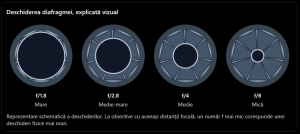
What happens at f/1.8?
The lens is wide open.
More light reaches the sensor than at f/4, under the same conditions.
You can use a lower ISO or a faster shutter speed.
On top of that, you can get a strongly blurred background.
What happens at f/8?
The aperture is more closed.
Less light gets through.
But the area that appears sharp can be larger.
This is useful when you want to photograph the chessboard together with several surrounding elements.
Practical example – You’re photographing two opponents
You have a 50 mm lens.
At f/1.8 you focus on the eyes of the player in front. The opponent, at a different distance, may become blurred.
At f/5.6 you can keep more elements in focus, depending on their position.
But if you close down the aperture, you have to compensate for the lost light with a slower shutter speed or a higher ISO.
And this is where the three settings start working together.
When do we use each value?
| Aperture | What you get | When it’s useful |
|---|---|---|
| f/1.4–f/1.8 | Lots of light, shallow depth of field | Portraits in low light |
| f/2–f/2.8 | Lots of light, well-separated subject | Portraits and gestures |
| f/4 | More context in focus | Player and board |
| f/5.6–f/8 | Greater depth of field | Hall shots and groups |
Not every lens allows all these values. If your lens has a maximum aperture of f/4, you can’t set it to f/1.8.
AF-C.ro tip: Aperture isn’t chosen only based on how dark the hall is. It’s also chosen based on what you want to be sharp in the photo.