
Focus On Perfection
Chess Photography – The Art of Capturing a War in Silence 4 Sections162 Lessons5 Quizzes10 Weeks
LESSON 3.1 • 8. Three chess photos, three different solutions
Now we’ll walk into an imaginary chess hall and solve three situations you may come across at a competition.
Situation 1 – The portrait of the focused chess player
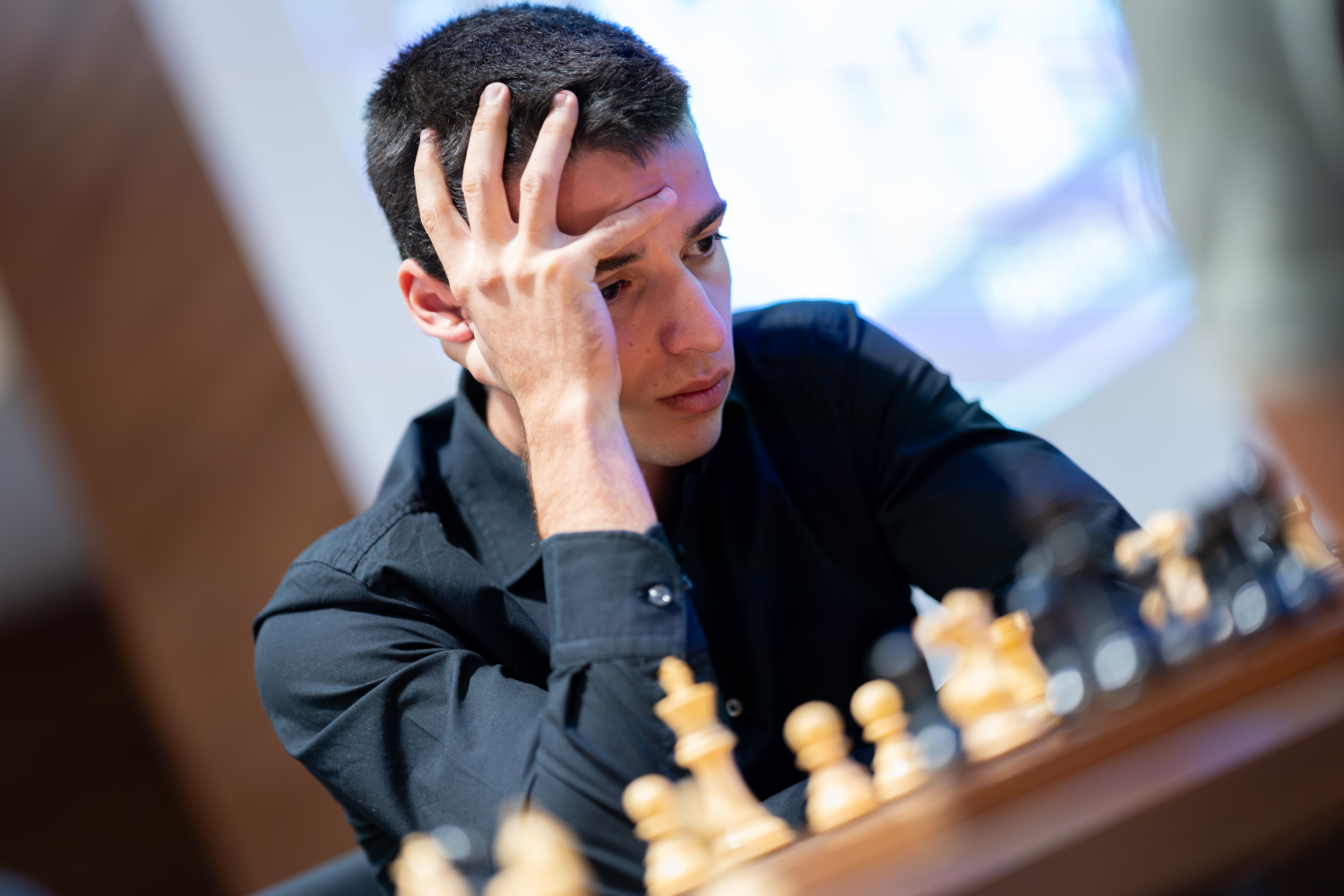
A player sits with his hand on his forehead.
He doesn’t move much.
In the background there are other tables and spectators.
You want to isolate his expression and keep the eyes sharp.
I’d start with:
1/250 s
Shutter speed
f/2.8
Aperture
Auto ISO
ISO
Why?
The shutter speed is fast enough as a starting point for the small movements of the face.
The f/2.8 aperture lets you separate the subject from the background.
Auto ISO adapts the brightness rendering to the conditions you encounter, within the camera’s limits.
If you notice the player is sitting completely still and the ISO is very high, you could try 1/160 s, taking into account stabilization and the risk of motion.
But check the photo.
Don’t assume it came out sharp just because it looks good on the small screen.
Situation 2 – The hand moving the piece
The player reaches for a piece.
The gesture lasts a very short time.
You want to capture the hand sharp, the piece and part of the chessboard.
I’d start with:
1/500 s
Shutter speed
f/2.8
Aperture
Auto ISO
ISO
Why 1/500 s?
Because the hand moves, sometimes quite fast.
If the gesture is slow, a slower shutter speed may be enough.
If it’s very fast, you might need 1/800 or 1/1000 s.
The aperture also needs to be chosen based on how much of the hand and the piece you want to stay sharp.
If you use f/1.4 from very close, only a very small portion may be in focus.
So don’t just chase the light.
Chase the photo you want to get.
Situation 3 – Blitz chess, when the fingers move faster than the photographer
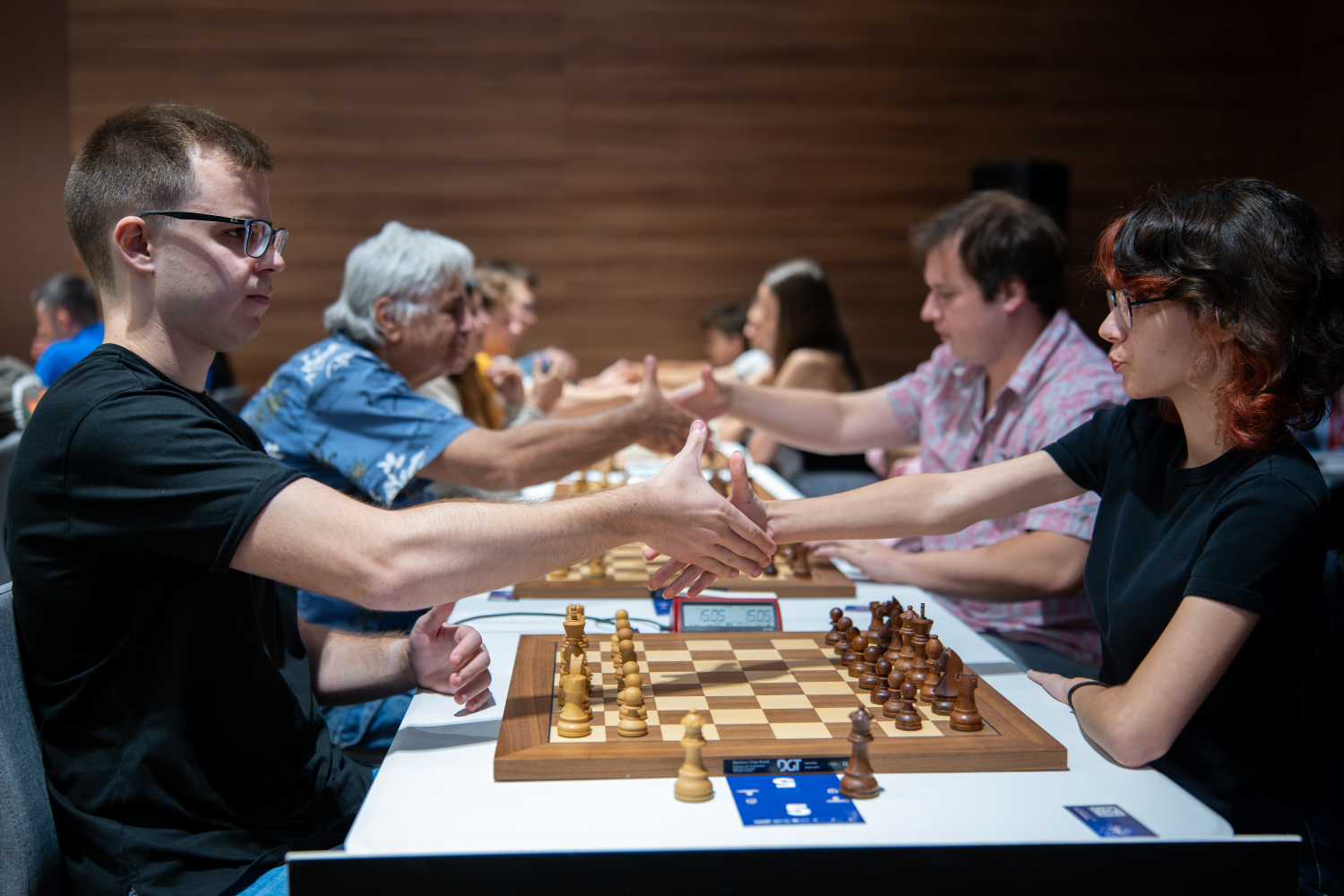
We have a blitz game.
The players move very fast.
The hands go from the board to the clock.
The pace is completely different from that of a classical game.
I’d start with:
1/1000 s
Shutter speed
f/2–f/2.8
Aperture
Auto ISO
ISO
But there are two problems here.
The first is the light.
If the hall is dark, a shutter speed of 1/1000 s may force a very high ISO or lead to underexposure if the ISO limit is reached.
The second is the electronic shutter.
Under certain conditions, it can produce banding or rolling shutter distortion, especially with very fast movements.
That’s why it’s not enough to choose a fast shutter speed.
You need to test your camera, understand its limits and respect the competition rules.
10. Why do I recommend learning M mode + Auto ISO?
So far you’ve seen that each type of photo requires different priorities.
That’s why, for many sports and event situations, I find Manual mode combined with Auto ISO very useful.
Does it seem like a contradiction?
Manual mode, but with an automatic setting?
No.
You set the shutter speed and the aperture, and the camera can adjust the ISO according to the measured light.
For example:
You photograph a player at 1/250 s and f/2.8.
The light in one part of the hall is good.
The camera selects ISO 1600.
You move to a darker area, if you have permission.
The camera may go up to ISO 3200 or 6400.
You don’t have to change all the settings right away.
But you have to keep an eye on the result and not let the camera reach maximum ISO without noticing.
What is the Auto ISO limit?
On many cameras, you can set a maximum value for Auto ISO.
For example, ISO 6400 or ISO 12800.
But if the limit is reached and the camera still can’t render the scene brightly enough, the photo may come out underexposed.
Auto ISO doesn’t create extra light.
And exposure compensation?
In M + Auto ISO mode, many modern cameras allow exposure compensation, but the implementation varies.
It affects the brightness level the automatic system tries to achieve.
It can be useful when the subject is dressed in black or when the background is very bright.
Don’t change exposure compensation at random.
Look at the scene, check the histogram and the exposure, and understand what you’re trying to correct.